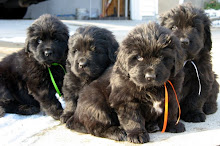
"There are few facts and much speculation about the origins of the Newfoundland Dog. Almost everyone who’s written a book about Newfs offers a variation on the breed’s genesis. There isn’t even consensus that there was an indigenous canine as the foundation. Some believe that the Newfoundland Dog was created solely through the interbreeding of various breeds brought from Europe by early fishermen.
The greatest consensus is on the place of origin – the island of Newfoundland. The commonest theory is that the native people on the island had the foundation canines, and that these dogs descended from Tibetan Mastiffs with two possible sources of this heritage. One conjecture is that when people migrated from Asia to Alaska, across what was then a land or ice bridge, they brought Tibetan Mastiffs with them. The other possibility is that the Vikings brought their big black bear dogs with them when they briefly colonized Newfoundland around AD 1000.
Some of these dogs, thought to be descended from Tibetan Mastiffs, were probably left behind and bred with native dogs. Modern speculation is that this latter happening was a reinforcement of the original heritage. There is also general agreement that various European dogs contributed to the genetic mix.
Another common belief is that the Newfoundland Dog, or its immediate ancestors, evolved on the island of Newfoundland in a semi-wild state.
Colonization of the island was restricted in the early years. Fishing admirals are said to have sent ships up and down the coast to burn down any homes with chimneys. This was done to force settlers to return to Europe for the winter, hence preventing permanent settlements and the governments that would follow.
Early writings claim that the big black dogs, left to their own devices for half the year, were not adept at catching food on land. In winter, this left only fish in the icy cold waters and the suggestion is that the dogs evolved into an underwater cold-water mammal like the polar bear. To this day, the Newfoundland is as different from other canine breeds as the polar bear is from other subspecies of bears.
History
In the 1700s, a large and powerful dog that worked extremely well on both land and sea was getting noticed. This dog was referred to by various names such as Bear Dog and Greater St. John’s Dog. It wasn’t until 1775 that the name “Newfoundland dog” first came into use.
At sea, the Newfoundland became the sailor’s darling. The dog had many uses, such as taking lines to shore, retrieving objects from the sea, carrying objects between ships, rescuing men who went overboard and helping to pull in fishing nets. They were equally useful on land doing draft work. They hauled the catch from the fishing boats and delivered fish and other merchandise door to door with their carts. Probably the most exotic of the door-to-door deliveries was the Royal Mail, which was transported in special wooden carts. Newfs in teams hauled the mail by sled between towns.
The Newfoundland Dog ran into trouble in its native land at the end of the 18th century. The best specimens were exported in great numbers to Europe, primarily to England, and the Government of Newfoundland restricted families from owning more than one dog, making any breed development on the island virtually impossible. Fortunately, the English carried out the breed’s ongoing development, especially in terms of the mastiff-type muzzle that makes modern Newfs look so different from their early ancestors, along with a longer neck, larger size and level bite.
Lord Byron summed up the wonderful respect the Newfoundland gained outside its native land with the famous epitaph for his beloved Newf, ‘Boatswain,’ who died in 1808: '... Beauty without Vanity, Strength without Insolence, Courage without Ferocity, and all the virtues of Man without his vices....'
Another Newfoundland Dog named ‘Boatswain’ was credited with altering human history. When Napoleon was escaping from his island exile in 1814, the non-swimmer emperor fell overboard, unnoticed in the dark except by the ship’s Newf who saved him, allowing him to go on to meet his Waterloo.
In the 1830s, Newfs performed a special type of rescue. After losing most of their St. Bernard breeding stock from disease and avalanches, the monks resurrected the famous giant Alpine-rescue dogs by crossing them with the giant water-rescue dogs. The rough or long coats found to this day on some Saints is a testimony to this event.
Although black was the Newfoundland’s original colour, the dogs arrived in England in a variety of colours, which were then almost eliminated. However, in 1837, the renowned painter Sir Edwin Landseer started painting white-and-black Newfoundlands and Queen Victoria acquired one such dog. The colour variation subsequently became the rage in England and the dogs became known as “Landseers.” This term is still in use in Canada, the United States and the United Kingdom; however the rest of the world has, since 1960, recognized another breed descended from white-and-black Newfoundland Dogs and the new breed has co-opted the name.
The Newfoundland has never been more popular than it was in the Victorian era when they became the “in” dog, renowned as children’s companions and protectors. This breed characteristic was reflected in children’s books of the time, the most famous J.M. Barrie’s story Peter Pan, which featured a Newfoundland nanny named ‘Nana.’
By the early 20th century, people were enamoured of the gentle bear-like dog and this, coupled with the fact that news reporting was somewhat less than diligent, resulted in some tales that are now being debunked by researchers.
The story of ‘Rigel,’ the Newfoundland Dog who saved the occupants of one of the Titanic’s lifeboats, and the legend of a Newf saving all the crew and passengers of the SS Ethie off the coast of Newfoundland in 1919, are now thought to have been fabricated.
Strict food rationing during World War I nearly caused the breed’s extinction. In 1923, only 23 Newfs were registered in Britain; by 1928, the number had climbed to just 75. National Geographic had declared the breed extinct in America.
Fortunately, a few dedicated breeders from England, Switzerland, the Netherlands, the United States and Canada fought to save the breed. In Canada, we are indebted to the Hon. Harold Macpherson, who founded the famous Westerland Kennels in St. John’s, Nwefoundland.
The first-ever dog stamp was issued by Newfoundland in 1887 – a rose-red half-cent stamp with the head of a Newfoundland Dog. In 1972, the Government of Newfoundland declared the Newf its official animal emblem.
The Newfoundland Today
Today, Newfoundlands are well established all over the world. While the majority live as loved family members, many still work. Both France and Italy employ the breed as lifeguards, some of them dramatically leaping out of helicopters. Earlier this year, a Newfoundland named ‘Bilbo’ became the first fully qualified canine lifeguard in England; he patrols a beach at Sennen Cove in Cornwall.
In Canada and the U.S., Newfoundland Dogs can qualify for the titles Water Rescue Dog and Water Rescue Dog Excellent, but their abilities as lifeguards have not yet been utilized by any government agency in North America.
On this continent, Newfoundland Dogs are regularly used in therapy, for search and rescue, avalanche rescue, locating cadavers and as mobility service dogs. In recent years, Newfs have been excelling in ‘crisis response,’ providing emotional support for victims and rescuers at major disasters such as Hurricane Katrina. Some families with autistic children have opted to have a Newfoundland rather than a trained service dog.
Newfoundlands are as active as ever as draft dogs, but pulling carts, wagons and sleds is mostly a recreational activity now. Besides qualifying for carting titles, you’ll find Newfs giving rides at winter fairs and participating in parades with their decorated carts and wagons. Some families hitch up their Newf to a cart for the evening walk so the younger or handicapped children get to ride.

Newfoundlands are renowned for their gentle temperament, especially with children; this is considered a hallmark of the breed. They are excellent draft dogs and when hauling records were kept by the Guinness Book of World Records, a Newf held the title for the greatest proportional weight hauled – 52 times its weight. They are the strongest canine swimmers and the only canine designed for underwater and cold-water swimming, even in the middle of winter.
Unique features include a bear-like roll when walking, a long oily outer coat, webbing between the toes when the fetal foot is formed, swimming with a modified breast stroke, a tail that acts as a rudder, and tolling for fish."
(Peter Maniate)