Saturday, June 4, 2022

The Newfoundland - Swimming, Italy, And The Wonder of Dogs With Lynne Cox

(sierranevadaally.org)
"Lynne Cox has seen a lot over the more than 35 years as an amateur, record-setting long-distance and cold water swimmer. Cox has swum in places like the Bering Strait, the English Channel, and Antarctica, writing about it all along the way. Now, her newest book, Tales of Al: The Water Rescue Dog, brings the reader to the coast of Italy, where Cox traveled to Scuola Italiana Cani Salvataggio – the School of Italian Water Rescue Dogs – to meet with the dogs and the trainers who prepare them.
Published May 24, Cox is currently on a book tour to promote Tales of Al. She’ll be headed to Reno for an event at Sundance Bookstore on Wednesday, June 8 at 6pm. For a taste of what the June 8 reading will look like, take a look at the conversation I had with Cox about her travels to Italy, the writing process, and the wonders of dogs, below. Claire Carlson (CC): Tales of Al’s first chapter is about your childhood and relationship with your childhood dog. Why did you choose to start this story here? Lynne Cox (LC): I grew up in a swimming family. Everyone, including our family dog Beth, a Dalmatian, knew how to swim. We all spent hot summers at our grandparent’s cabin in Maine, swimming together. So I thought it was really important to show this early influence of swimming with dogs and how much fun it was and how much we loved to do it. My parents were so supportive and gentle with us in the water and made sure we felt safe and learned to coordinate our arms and legs and as we are able to gain strength they let go of us. They taught Beth the same way. So now years later, I’ve watched people work with children and adults learning to swim and dogs and I’ve seen people being taught or children or dogs taught in a rough way, in a way that often scares them where they’re just thrown into the water and expected to swim. And I really disagree with that. I don’t think you should terrify a child or adult or a dog. And so that was part of my reason for being intrigued with how the dogs are being trained at the School of Italian Water Rescue Dogs and how they are able to eventually become athletes that are involved in water rescue.
CC: Your next chapter goes to present(ish) day of you watching a video of a Newfoundland dog from the School of Italian Water Rescue Dogs jumping out of a helicopter to rescue someone. Shortly after watching this video, you booked a trip to Italy. Can you tell me a little bit more about that decision, which seems like such a huge thing to do so spontaneously? LC: I saw this video and I watched it again and again and just marveled at the courage of these dogs, these Newfoundlands and – I later found out – it wasn’t just Newfoundlands, but Labradors and Golden Retrievers and German Shepherds and Leonbergers and Italian Spinones. How did they fly in helicopters and how did they learn this and how were they not afraid? I just started thinking, you know, I have to find out more about this. I was really intrigued. I’ve worked with athletes. I’ve been an elite athlete. I’ve coached swimmers who have had really bad experiences. And so I wanted to see if the dogs in Italy were being trained because they wanted to learn to swim, they wanted to participate or if they were being forced to do this. I also really admired the thought behind it of people spending time with their dogs to train them to help lifeguard and patrol the coast of Italy, and also Switzerland and Germany, which they go to as well. The video was an immediate inspiration because I love dogs, I love swimming, I love swimming with dogs, and I really wanted to see how they train the dogs at the school.
CC: You mentioned not agreeing with that fear-based approach to learning how to swim, and I think this message really comes through in the book. There’s a part where you talk about courage and what that means to different people, and how it was reflected in the dogs and trainers. Can you speak a little about this and the relationships you formed with the folks you met? LC: There was this amazing amount of trust that had been established between the dogs and their owners. And part of that was from positive reinforcement, from being so consistent, from realizing that if a dog reached a certain skill but then didn’t understand what to do, they would then back away and not force the dog to reach the next level, because they might not get it and then fail. So the whole philosophy was about building on success, and that success built competence and companionship and trust between the owner and the dog. And so it was really fantastic to suddenly be welcomed into this group. It was like if you’re on a team, any sports team, and you’re suddenly welcome to join them. There’s a sense of how lucky I am to be here. And that’s how I felt in Italy with the people and the dogs from the school. They were eager to answer questions and show me what they were working on and what the dogs had learned and what the instructors or the owners were doing. For somebody who’s curious and wanting to know about cultures and about dogs and about the world, I just felt like oh my gosh, this was such a great idea to just follow curiosity and go to Italy and participate.
CC: I want to zoom out and talk more about the writing process involved in this. When you went to Italy, you met these amazing people, these amazing dogs. Did you go into the experience thinking this would make a great book? How did this all come about? LC: Well, I actually was there about 10 years ago, and then I came back [to the U.S.] with the idea of okay, maybe I could write something about it. And then I started writing the book, and I didn’t like anything that I was doing. So I just put it aside and worked on other projects, other books. And then the pandemic happened and we had to isolate, and I started reflecting on how extraordinary the experience had been in Italy. And I just thought well, maybe this could be a story. So I started to write, and then it started reminding me of so many things in my life that related to it, and as I talked with my friends about it they mentioned things that had happened in their lives and how this story connected with them. And then I wrote the book. CC: Lastly, I wanted to ask about the inspirations you drew from writing Tales of Al. The epigraph of the book is a line from Mary Oliver’s Dog Songs: “Because of the dog’s joyfulness, our own is increased. It is no small gift.” What influence has she had on your work? LC: I love Mary Oliver’s poetry. I love the way she writes about dogs. I love what she writes about life and nature and hope. I’ve read a lot of her work and she reminds me a lot of Robert Frost, but I think she has a little bit more uplift to her poetry. She’s written a number of poems about dogs and I just thought what she expressed in that single sentence is the way so many of us who love dogs feel about dogs, how they multiply our joy and how that is not a little thing. It’s really a very special, almost miraculous thing, you know?"

Monday, May 30, 2022

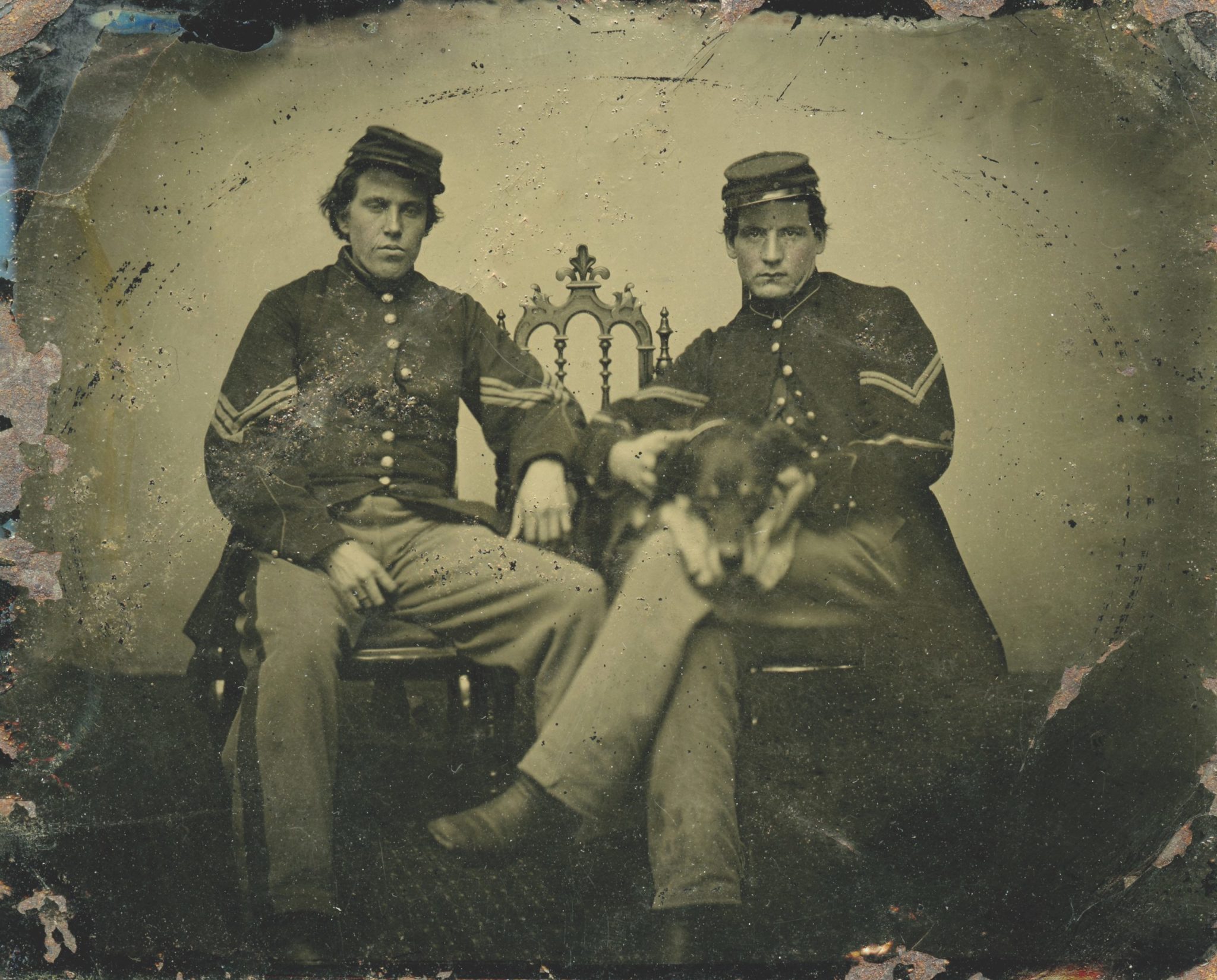
The Newfoundland (And Other Canine) Heroes Of The CIvil War

(The Newfoundland In History - The Newfoundland.org)
"When Johnny Reb and Billy Yank marched off to war, chances are that a four-footed or winged creature went with them. Wartime animal mascots demonstrated bravery and loyalty, and earned the affections of their human counterparts. Dogs and horses were most commonly mascots for regiments, but a dignified eagle, a lumbering bear, and a sheep also had their place in camp and on the battlefield. Some Civil War mascots were an inspiration for the troops, while others were a reminder of beloved pets at home. Mascots brought loyalty and enthusiasm, and for soldiers, the act of nurturing animals also offset boredom in camp. Some accounts of Newfoundlands serving as mascots during the civil war include: "A large dog called 'Tony' who was a beautiful Newfoundland Dog lovingly cared for by the Chicago Light Artillery Battery A. He was called the 'Battery dog.' Tony was a dog of action and gave no thought to the bullets zipping all around him. He was on the battlefields at South Mountain and the wounded at Fort Donelson. He saw action again at Shiloh. He never got separated from his men so when he came up missing at Antietam the worst was feared. Unfortunately, he was killed and found beside the body of W.J. Pollock, Co H. 20th New York Infantry." The 104th Ohio was truly a group of animal lovers, adopting as their mascots a cat, a tame raccoon, a white bulldog named 'Old Harvey' and a Newfoundland.
"On the sixth of October, eighteen hundred and sixty one, as the regiment was on it's way to the seat of war, there came on board the train at Portsmouth, New Hampshire, a large, black, Newfoundland dog, weighing considerably upwards of one hundred pounds. Entering the car occupied by company H, Capt. Emerson, he was adopted by the members of that company and christened 'Major.' From that time until May eight, eighteen hundred and sixty-three, when the regiment was mustered out of service, he continued a member of this company, (never but once deigning to recognize a person belonging to any other, and that during Banks' retreat from Winchester when he became so crippled from continuous travel that it was with the utmost difficulty he could proceed,) sharing with almost human patience and fortitude all the vissitudes of camp life, with as much sense of duty, apparently, as if he had been duly enlisted and mustered for the war." Major went on to serve with the 29th Maine, where he was killed at the Battle of Mansfield Landing in Louisiana.
In a retelling of the incidents at Pittsburgh Landing (also known as Shiloh) "Private John K. Ferguson, company K, Sixty-fifth Ohio, who was killed in the second day's battle, was accompanied to camp by a young Newfoundland dog, who had persistently followed him from the time of his enlistment, and from camp to camp, to the moment of his death. Two days after the battle the faithful dog was found lying upon the inanimate breast of his master; nor would he consent to leave the spot until the remains were buried."
A history of the famous Iron Brigade, the 6th Wisconsin relates the following from the Battle of Antietam: "At the very farthest point of advance on the turnpike, Captain Werner Von Bachelle, commanding company F, was shot dead. Captain Bachelle was an ex-officer of the French army. Brought up as a soldier in the Napoleonic school, he was imbued with the doctrine of fatalism. His soldierly qualities commanded the respect of all, and his loss was deeply felt in the regiment. Bachelle had a fine Newfoundland dog, which had been trained to perform military salutes and many other remarkable things. In camp, on he march and in the line of battle, this dog was his constant companion. The dog was by his side when he fell. Our line of men left the body when they retreated, but the dog stayed with his dead master, and was found upon the morning of the 19th of September lying dead upon his body. We buried him with his master. So far as we know, no family or friends mourned poor Bachelle, and it is probable that he was joined in death by his most devoted friend on earth."

Wednesday, May 25, 2022

Satchie - Happy Birthday In Heaven

Happy Birthday in Heaven "I wish you were here today even for just a little while so I could say Happy Birthday 'Satchie' and see your beautiful smile. The only gifts today will be the gifts you left behind; The laughter, joy and happiness... precious memories...the best kind. Today I'll do my very best to try and find a happy place... struggling to hide my heavy heart and the tears on my face. I'll sit quietly and look at your picture thinking of you with love; hoping you're doing ok in Heaven up above. May the angels hold you close and sing you a happy song... and I'll be sending wishes to you today and all year long." Bless you Satchie, my compass star.

Saturday, May 14, 2022

Newfies Working With The Coast Guard

(First Coast News: February 8, 2022) FORT LAUDERDALE: "The United States Coast Guard Station in Fort Lauderdale welcomed a special guest Monday to do training on water safety and rescue. Angel, a Newfoundland, along with his team, are from the American Academy of Canine Water Rescue. The nonprofit organization breeds and trains dogs to perform water rescues. Among the breeds the organization uses are Newfoundland Dogs and Labrador Retrievers."
"Dogs like Angel wear specialized flotation devices during their rescues and can swim up to one mile for a rescue, according to the Coast Guard. Additionally, Angel can tow more than 10 adults at a time. Angel travels around the country for demonstrations and to teach people about water safety."

Saturday, April 23, 2022

Saturday, April 9, 2022

Seizing The Moment From A Wise Old Dog

(The Interior News - Thom Barker March 17, 2022)
"Back by popular demand, an update on living with Lady MacBeth (a.k.a. The Bug). Actually, while readers have been asking for it, this was more of a reflection on life and death. I realized recently that in six months — six months and five days to be precise — The Bug is going to be eight years old. Quite aside from the fact that the two of us have been virtually inseparable for seven-and-a-half years, where the heck did that time go? When I bought Lady MacBeth for my (now officially) ex-wife, I had never had a dog, had never wanted a dog, had never fathomed that I could get attached to a dog. But life is funny. Now, it actually feels weird to write the above line about buying her, as if she is a piece of property like a bass guitar, or a television, or a car. I don’t feel that way about her at all. At first, I didn’t really want to have anything to do with her. Now, I can barely imagine my life without her. And yet, I have to face the reality, she is going to be eight years old. Newfoundland dogs typically have a lifespan of eight to 10 years. PetMD says they are prone to vserious health conditions such as gastric torsion, Sub-Aortic Stenosis (SAS), cystinuria, canine hip dysplasia (CHD), epilepsy, and elbow dysplasia, and minor issues like von Willebrand’s Disease (vWD), cataract, Osteochondrosis Dissecans (OCD), entropion, and cruciate ligament rupture. I feel lucky I don’t know what most of those things mean, but technically, The Bug should be on her last legs. Now, she has slowed down a little bit, but she has never exhibited any signs of any real health problems. I like to think I have had a significant role in that. I have always kept her very lean. She has a very fixed diet (with a judicious smattering of treats) and I give her plenty of exercise. Still, there will come a time, and it will likely not be that far off when I will have to say goodbye to this most special of friends. If the reaper doesn’t get me first, of course. I know when that day comes, I will be absolutely devastated. In fact, just thinking about it, I feel the sadness well up in my gut and expand until it almost engulfs me raising the question: why do we do it? We invite these wonderful companions into our lives knowing full well it ends in heartache. It doesn’t happen often, and I try not to dwell on it, but perhaps it is a good thing that it does. It reminds me to seize the moment and love that dog as much as I can for as long as I can. And that is something we should apply to all aspects of our impermanent lives."