Sunday, July 10, 2022
Newfoundland Joins Lifeguards At Scarborough Beach State Park
(By Drew Johnson - The Forecaster - July 5, 2022)
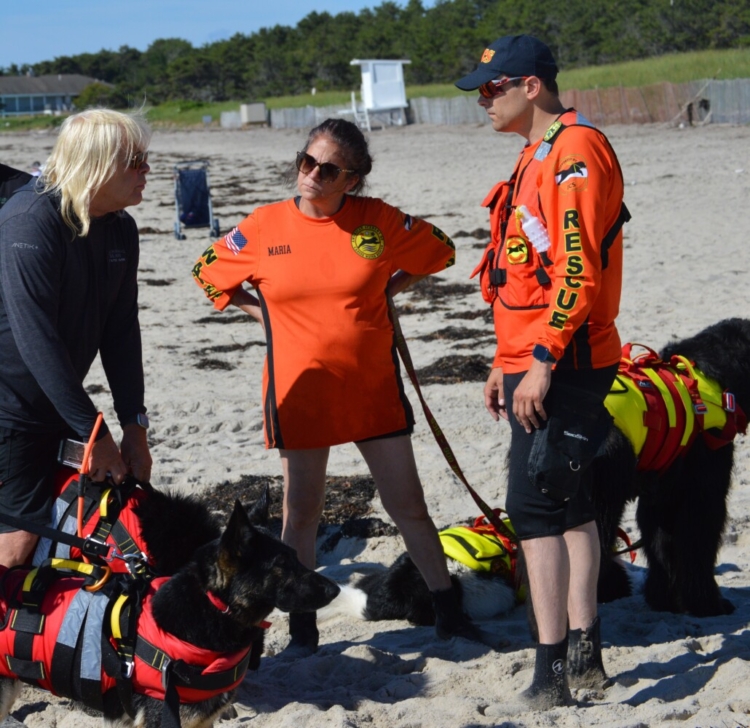
Five dogs took to Scarborough Beach State Park last week, but not to play fetch or go for a walk.
Beacon, a 14-month-old Newfoundland, is training to help lifeguards save lives. Two visiting dogs were there to train Beacon and the two other canines.
“(Beacon) won’t be a first responder; she’ll be a second responder,” said Park Manager Greg Wilfert. “What her job will be is to help the lifeguards bring the people back in. I have all my lifeguards working with her.”
Beacon has been working with trainers from the American Academy of Canine Water Rescue, based in Massachusetts.
It’s quite a spectacle when Beacon trots along the shore wearing her life jacket. Beachgoers stop to pet and take photos of her and ask Wilfert a lot of questions. The idea of a professionally trained water rescue dog is, quite literally, foreign.
“I had seen the groups from Italy and Croatia that use dogs as water rescue dogs,” Wilfert said. “I just thought it was another tool that could be utilized like our Jet Ski is. You don’t use it all the time, but you have it there for a purpose.”
Italy has certified 400 water rescue dogs via the Scuola Italiana Cani Da Salvataggio, or Italian School of Rescue Dogs. Two of them — Angel and Oakley — and their owners were invited to Scarborough Beach on June 30 to help train Beacon and the two other dogs, a German Shepard named Athena and a 4-month-old Newfoundland named Orso.
The latter spent the morning soaking up the sun and studying his peers.
Angel, also a Newfoundland, was the first dog from the United States to be certified in water rescue in Italy.
“That’s one of the reasons why I founded the American Academy of Canine Water Rescue,” said Maria Gray, who also owns Angel. “I want to bring their techniques and their philosophy and their methodology here to the United States.”
Over 10 people drown in the United States every day, Gray said, a statistic that doesn’t account for those who suffer severe injuries and brain damage from accidents on the water.
“It’s 100% preventable if you follow basic rules, if you swim with a buddy, if you wear a life jacket on open ocean water,” Gray said. “We strive to educate, but we also work to train these dogs to actually be able to conduct a rescue.”
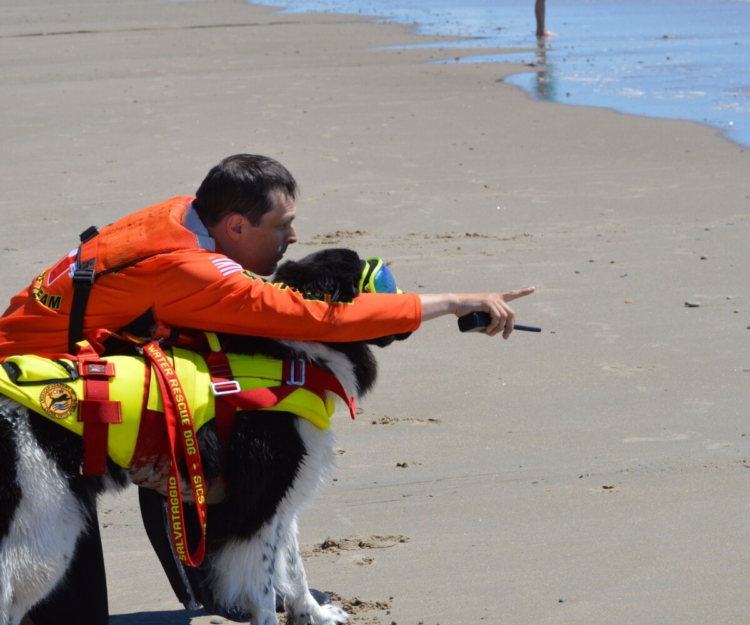
Oakley, a black and white Newfoundland, also known as a Landseer, was also there to teach the dogs some new tricks. She drew quite the crowd in Scarborough Thursday, in part due to her eyewear.
“The goggles are probably the most noticeable thing,” said George Abraham, lead instructor at the American Academy of Canine Water Rescue, and Oakley’s owner. “They’re made specifically for working dogs.”
The goggles function as sunglasses but also help protect Oakley’s eyes from sand and salt water, which is often kicked up when she and Angel jump out of helicopters in the Mediterranean Sea as part of their open-water rescue training.
Beacon will not be jumping out of any helicopters on Wilfert’s watch, but she does ride on a personal watercraft.
“Beacon’s been out on the Jet Ski, she’s made simulated water rescues,” Wilfert said. “(Lifeguards) have to work with her four to five times a day on certain training aspects.”
Advertisement
Much of that includes obedience, like staying when told and walking alongside her assigned lifeguard on patrols. While those may seem like simple tricks, it’s important for water rescue dogs to instantly follow commands. Fortunately for Beacon, Oslo and Athena, they are learning from one of the best: Oakley.
“She’s traveled around the world, 99.9% of the time off-leash,” Abraham said.
Throughout the interview, and for much of Thursday morning, Oakley didn’t move in the midst of the crowded beach.
“She always keeps eye contact; if I go somewhere, she’s going to start looking,” Abraham said, taking no more than three steps across the beach. “She looked. She always knows where I’m at, she’s always waiting for her next command.”
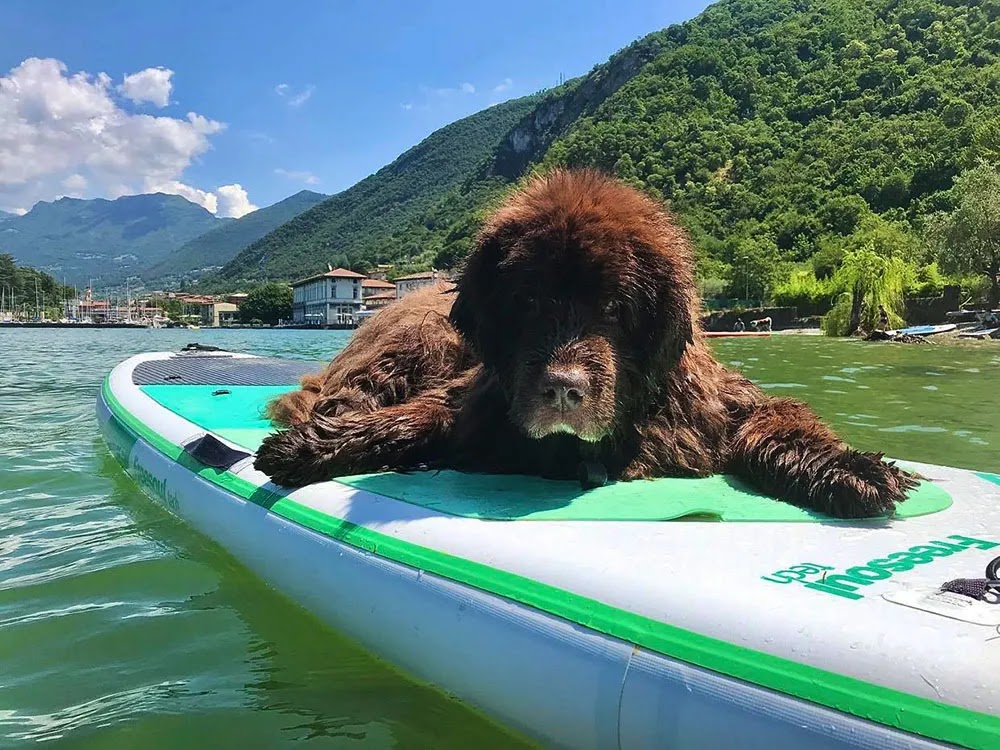
While any dog of “sufficient size” and strength can be trained, Newfoundlands are often in a class of their own when it comes to water rescue. They have webs between their toes, use a swimming style more similar to a human’s than a doggy paddle, and have three coats of fur, “which keeps them dry even in the coldest waters.
“The Newfoundland is the only dog that can swim in Arctic waters without dying of hypothermia,” Gray said. “They’re incredible.”
Working with Angel and Oakley, Wilfert said, requires Beacon to do a lot of watching and studying. When Oakley performed a simulated rescue mission, Wilfert made sure Beacon was watching.
In the simulated mission, a lifeguard plays the role of a drowning swimmer. Another lifeguard, the first responder, swims out to help and signals back to the beach for backup. That’s when the second-responding lifeguard comes to the rescue along with a dog.
The dogs are trained to tow the lifeguards and distressed swimmers to shore by tugging on a rope attached to the floating devices lifeguards bring out to support the victim. It’s a strategy that permits one lifeguard to give their full attention to the swimmer and increases the speed of the rescue.
“The dog allows me to, much more quickly, get to a person in distress and helps me get back to a boat or the shore,” Gray said.
The dogs also help the lifeguards navigate. During Oakley’s simulation, she did not swim directly to the shore, but at a slight angle. Using their intuition, the dogs are able to find the path of least resistance, Wilfert said, accounting for the wind and waves. When it was Beacon’s turn to simulate the mission, she used the same tactic, alongside Angel as her mentor.
The session at Scarborough Beach was also a learning experience for Angel and Oakley. They usually train in the open ocean or lakes and ponds, so the experience at the beach trains them to overcome the waves crashing on the shore.
In Italy, where water rescue dogs have been trained and certified for 30 years, Gray said, dogs are responsible for saving hundreds of lives each year. In an effort to make rescue dogs more widely used, Angel and Oakley have performed demonstrations for U.S. Coast Guard bases across the country.
Meanwhile, Beacon is progressing at a fast rate, and it seems Scarborough Beach lifeguards will have a four-legged, tail-wagging companion to lean on for some time.
“Beacon’s only 14 months, going on 15 months old,” Wilfert said. “She’s very young to be at this stage, and she’s learned a lot with Angel and Oakley … that’s why they’ve been invited here to train on the beach; so that Beacon can see their dogs in action.”
Sunday, July 3, 2022
Seaman - A Newfoundland Dog Who Accompanied Lewis and Clark
(Americacomesalive.com)
"Lewis and Clark’s Corps of Discovery Expedition was commissioned by President Thomas Jefferson shortly after the Louisiana Purchase in 1803. Jefferson asked Captain Meriwether Lewis to head up a select group that partially consisted of U.S. Army volunteers; Lewis was to be aided by his good friend, Second Lieutenant William Clark. Their primary goal was to explore and map the newly acquired territory and find a practical route across an essentially unexplored part of the continent. It was a risky journey, and no one could predict how long the Corps would be gone.
The group planned to depart from St. Louis in the spring of 1804, and Seaman was thought to have been purchased by Meriwether Lewis for $20 while he was in Pittsburgh waiting for the completion of the boats that would be taken on the journey. There is no record as to why Lewis selected a Newfoundland—whether it was simply a dog that caught his attention or whether he selected Seaman because the breed is known for being smart and strong with good swimming ability.
Occasionally readers may find the Newfoundland referred to as Scannon. In 1916 Lewis’ handwriting was misinterpreted by a historian, and the dog’s name was written as Scannon. Not until 1987 was the mistake discovered. Historian Donald Jackson was at work with the material and re-examined the journals, realizing that the dog’s name was actually Seaman.
As one would expect, the Corps of Discovery participants were totally occupied finding their way through country they did not know, coping with adversity, and documenting their discoveries—both the routes taken as well as notes on flora and fauna found along the way. Seaman is mentioned only on an 'as necessary' basis – at times of crisis or when Meriwether Lewis had a little extra time and the dog’s story illustrated a point.
One of the first mentions of the dog is as Lewis and Seaman departed from Pittsburgh on August 30, 1803. Lewis writes that Seaman was skilled at catching and killing squirrels, which Lewis found excellent to eat once 'fryed.'
Once on the journey, Seaman attracted positive attention from the Shawnees who offered three beaver skins for the dog, but Lewis said no. Later Seaman also was reported as a favorite of a 'buffaloe calf' that followed them along the shore until Lewis and Seaman re-boarded the boat.
Seaman had some nights when he would wander and explore on his own, and occasionally, Lewis expressed concern in his journal entries, but each morning Seaman returned to accompany the group on the next leg of the trip.
On May 19, Lewis notes that Seaman was seriously hurt. One of the men had shot and wounded a beaver, and when Seaman went out to retrieve it, the animal bit him through the hind leg, cutting an artery. Both Lewis and Clark took extraordinary medical measures to save Seaman, and fortunately, the dog pulled through.
And only ten days later, Seaman was credited by the men with saving the expedition. During the night a buffalo bull charged through the camp. Another member of the party, Sergeant Ordway, documented in his journal that the great beast passed 'between 4 fires & within a few inches of Several men; it was Supposed if he had trod on a man it would have killed him dead. The dog flew at him which turned him from running against the lodge [in] which the officers layed, [and] he passed without doing more damage than [breaking the stalk] of a rifle & injuring one of the blunderbusses [muzzle-loading firearm] in the pirogue [type of boat used for the expedition] as he passed through.'
The occurrence had the entire camp in an uproar, with everyone up and armed. After greater wakefulness, they realized that thanks to Seaman the threat had passed.
Lewis’ journals also note that Seaman was plagued by some of the same annoyances of nature that bothered the men. Mosquitoes were everywhere: 'the mosquitos continue to infest us in such manner that we can scarcely exist…my dog even howls with the torture he experiences from them, they are almost insupportable, they are so numerous that we frequently get them in our throats as we breathe.'
Another irritation to man and beast were the barbed seeds of the foxtail. Seaman’s heavy coat, which helped him withstand the cold from swimming in icy water, made him a good target for carrying these seeds. Lewis wrote: These 'penetrate our mockersons and leather legings and give us great pain until they are removed. My poor dog suffers with them excessively, he is constantly binting and scratching himself as in a rack of pain.'
Other adventures of Seaman are described here and there in the journals, but for almost a year (August 1805 to July 1806), Seaman is not mentioned. Then in July of 1806 there is a journal entry noting that a creek was being named in Seaman’s honor. This left historians with the impression that Seaman was still alive. Most also feel that if anything had happened to him, the event would have been recorded.
After the trip there is no mention of Seaman as part of Lewis’ life, but author and historian James J. Holmberg has done some additional sleuthing to determine what happened to the dog.
Eventually Holmberg came upon some information in a book published in 1814 that leads him to believe that Seaman survived the trip and continued to make his life with Meriwether Lewis. The book that led Holmberg to this conclusion was a book of epitaphs and inscriptions of the day, recorded by a clergyman and educator named Timothy Alden.
According to Holcomb, Entry 916 of American Epitaphs and Inscriptions lists an inscription that was on a dog collar that had been donated to a museum in Alexandria, Virginia. The inscription read:
'The greatest traveler of my species. The name is SEAMAN, the dog of captain Meriwether Lewis whom I accompanied to the Pacifick ocean through the interior of the continent of North America.'
The additional details noted by Alden had to do with the period following Meriwether Lewis’ untimely death in 1809. Lewis had suffered from depression for many years but whether the death was suicide — as most historians feel — or murder is still an ongoing discussion.
Alden’s note following the inscription was this (exactly as it was written): 'The fidelity and attachment of this animal were remarkable. After the melancholy exit of gov. Lewis, his dog would not depart for a moment from his lifeless remains; and when they were deposited in the earth no gentle means could draw him from the spot of interment. He refused to take every kind of food, which was offered him, and actually pined away and died with grief upon his master’s grave.'
Unfortunately the collar cannot be found. The museum suffered a fire in 1871 when many artifacts were lost. The ledgers from that period still exist but Holmberg notes that while they did not mention the donation of a dog collar, they also appeared to be generally incomplete.
Despite this, Holmberg’s discovery of the information in Alden’s book does add an interesting possibility to what may have happened to Seaman."
Sunday, June 26, 2022
Happy Birthday Andrew
"I wish you were here today
even for just a little while
so I could say Happy Birthday 'Andrew'
and see your beautiful smile.
The only gifts today will be
the gifts you left behind;
The laughter, joy and happiness...
precious memories...the best kind.
Today I'll do my very best
to try and find a happy place...
struggling to hide my heavy heart
and the tears on my face.
I'll sit quietly and look at your picture
thinking of you with love;
hoping you're doing ok
in Heaven up above.
May the angels hold you close and
sing you a happy song...
and I'll be sending wishes to you
today and all year long."
Saturday, June 25, 2022
Dog From Newfoundland Wins Breed At Westminster
(CBC News)
"A dog from a breeding business owned by Newfoundland and Labrador's deputy premier won Best of Breed at the 146th Westminster Kennel Club Dog Show in New York on Wednesday."
"Siobhan Coady, also the province's finance minister, told CBC News the win makes Beau, a Labrador retriever, one of the top dogs in the world.
'To have him here at Westminster, to see him stack up against the best of the best, it certainly is an honour,' Coady said.
Beau, whose full name is Beaumont Hamel, was bred by GoFetch Labradors, the St. John's dog breeding business run by Coady and her husband.
'My husband and I have been breeding Labradors because we wanted to have the best Labradors in the world,' she said. 'They're a heritage animal in Newfoundland and Labrador and they're the best animals in the world.'
The retriever's name holds significance for Newfoundland and Labrador too — Beaumont Hamel is the site in France where more than 700 members of the Newfoundland Regiment were killed, wounded or went missing on July 1, 1916, during the First World War.
Coady said Beau, who was already a grand champion in both Canada and the United States, won the title Best of Breed out of 67 dogs.
He was led to his win by dog handler and co-breeder Fabian Negron, who said he was "thrilled" with Beau.
'Every single box was checked. His attitude was there. His movement was there. He just put on a fantastic performance and the judge recognized it,' he said.
Negron said the Best in Breed title is "amazing recognition" for Beau, as well as for his owners and breeders.
'We're just very excited and we just want the people of Newfoundland to know how proud we are to be representing the breed with one of their own,' Negron said.
Coady owns Beau's mother, Jersey, and Negron owns his father. Despite his world-champion status, Coady said Beau is 'a sook.'
'He's a lovely, kind, sweet dog. He's a typical Labrador retriever. He likes to swim and likes to fetch. He likes to sleep. He likes to give kisses. He's a really kind and gentle soul,' Coady said.
Coady said Beau will be featured in a dog show in Bay Roberts this summer."
Sunday, June 19, 2022
For Henry - The Dog From Newfoundland
THE LEGEND OF THE NEWFOUNDLAND DOG
"There is a land where the waves explode upon the reef in a boiling foam, there the legend was born. As the story is told, God turned one day to contemplate all of his creations and saw on that Newfoundland Isle, flailed by storm a small nation of fishermen, whose rough, weather-beaten people fought courageously against the impervious elements of nature as the freezing cold winter and the unforgiving coastline took its toll, and the sea often asked the sacrifice of human life. Nevertheless, they remained deep-rooted, these men of Newfoundland with the stubbornness as great as their courage. God saw, and in his infinite compassion, thought how he might alleviate their suffering. He searched among the creatures of his creations but found none that would serve. It was then he decided to create one anew. He took the body of a bear, whose bone structure lent well to such arduous labours and whose thick fur would resist the bitter Newfoundland cold. Then he thought to sweeten this silhouette with the lithe, flexuous lines and movements of the seal, with all its prowess to swim and speedily slip between the waves. Now turning to the sea, he saw the playful dolphins happily following the ships, their sweet, joy-filled eyes revealing their serene temperament, and more; they so love man that they often rescue them, saving them from the sea. Yes, they too would be part of this creature. When he had done the moulding and casting, there suddenly appeared in his creative arms, a superb animal with glistening black fur; powerful and sweet in the same moment. This new being, however, had to have an allegiance and faithfulness, tried and true, to be able to live beside man and be ever ready to offer his life for his master. It was at that moment that the Lord opened and placed in his chest, the heart of a dog, and the miracle was complete. From that day onward, those men of the sea had beside them, their courageous companion ever strong, ever faithful, the Newfoundland Dog." (Reprinted in translation from the book "Il Cane Di Terra Nova" by Emmy Bruno, editor Mursia-Milano)
Saturday, June 4, 2022
The Newfoundland - Swimming, Italy, And The Wonder of Dogs With Lynne Cox
(sierranevadaally.org)
"Lynne Cox has seen a lot over the more than 35 years as an amateur, record-setting long-distance and cold water swimmer. Cox has swum in places like the Bering Strait, the English Channel, and Antarctica, writing about it all along the way. Now, her newest book, Tales of Al: The Water Rescue Dog, brings the reader to the coast of Italy, where Cox traveled to Scuola Italiana Cani Salvataggio – the School of Italian Water Rescue Dogs – to meet with the dogs and the trainers who prepare them.
Published May 24, Cox is currently on a book tour to promote Tales of Al. She’ll be headed to Reno for an event at Sundance Bookstore on Wednesday, June 8 at 6pm. For a taste of what the June 8 reading will look like, take a look at the conversation I had with Cox about her travels to Italy, the writing process, and the wonders of dogs, below.
Claire Carlson (CC): Tales of Al’s first chapter is about your childhood and relationship with your childhood dog. Why did you choose to start this story here?
Lynne Cox (LC): I grew up in a swimming family. Everyone, including our family dog Beth, a Dalmatian, knew how to swim. We all spent hot summers at our grandparent’s cabin in Maine, swimming together. So I thought it was really important to show this early influence of swimming with dogs and how much fun it was and how much we loved to do it. My parents were so supportive and gentle with us in the water and made sure we felt safe and learned to coordinate our arms and legs and as we are able to gain strength they let go of us. They taught Beth the same way. So now years later, I’ve watched people work with children and adults learning to swim and dogs and I’ve seen people being taught or children or dogs taught in a rough way, in a way that often scares them where they’re just thrown into the water and expected to swim. And I really disagree with that. I don’t think you should terrify a child or adult or a dog. And so that was part of my reason for being intrigued with how the dogs are being trained at the School of Italian Water Rescue Dogs and how they are able to eventually become athletes that are involved in water rescue.
CC: Your next chapter goes to present(ish) day of you watching a video of a Newfoundland dog from the School of Italian Water Rescue Dogs jumping out of a helicopter to rescue someone. Shortly after watching this video, you booked a trip to Italy. Can you tell me a little bit more about that decision, which seems like such a huge thing to do so spontaneously?
LC: I saw this video and I watched it again and again and just marveled at the courage of these dogs, these Newfoundlands and – I later found out – it wasn’t just Newfoundlands, but Labradors and Golden Retrievers and German Shepherds and Leonbergers and Italian Spinones. How did they fly in helicopters and how did they learn this and how were they not afraid? I just started thinking, you know, I have to find out more about this. I was really intrigued. I’ve worked with athletes. I’ve been an elite athlete. I’ve coached swimmers who have had really bad experiences. And so I wanted to see if the dogs in Italy were being trained because they wanted to learn to swim, they wanted to participate or if they were being forced to do this. I also really admired the thought behind it of people spending time with their dogs to train them to help lifeguard and patrol the coast of Italy, and also Switzerland and Germany, which they go to as well. The video was an immediate inspiration because I love dogs, I love swimming, I love swimming with dogs, and I really wanted to see how they train the dogs at the school.
CC: You mentioned not agreeing with that fear-based approach to learning how to swim, and I think this message really comes through in the book. There’s a part where you talk about courage and what that means to different people, and how it was reflected in the dogs and trainers. Can you speak a little about this and the relationships you formed with the folks you met?
LC: There was this amazing amount of trust that had been established between the dogs and their owners. And part of that was from positive reinforcement, from being so consistent, from realizing that if a dog reached a certain skill but then didn’t understand what to do, they would then back away and not force the dog to reach the next level, because they might not get it and then fail. So the whole philosophy was about building on success, and that success built competence and companionship and trust between the owner and the dog. And so it was really fantastic to suddenly be welcomed into this group. It was like if you’re on a team, any sports team, and you’re suddenly welcome to join them. There’s a sense of how lucky I am to be here. And that’s how I felt in Italy with the people and the dogs from the school. They were eager to answer questions and show me what they were working on and what the dogs had learned and what the instructors or the owners were doing. For somebody who’s curious and wanting to know about cultures and about dogs and about the world, I just felt like oh my gosh, this was such a great idea to just follow curiosity and go to Italy and participate.
CC: I want to zoom out and talk more about the writing process involved in this. When you went to Italy, you met these amazing people, these amazing dogs. Did you go into the experience thinking this would make a great book? How did this all come about?
LC: Well, I actually was there about 10 years ago, and then I came back [to the U.S.] with the idea of okay, maybe I could write something about it. And then I started writing the book, and I didn’t like anything that I was doing. So I just put it aside and worked on other projects, other books. And then the pandemic happened and we had to isolate, and I started reflecting on how extraordinary the experience had been in Italy. And I just thought well, maybe this could be a story. So I started to write, and then it started reminding me of so many things in my life that related to it, and as I talked with my friends about it they mentioned things that had happened in their lives and how this story connected with them. And then I wrote the book.
CC: Lastly, I wanted to ask about the inspirations you drew from writing Tales of Al. The epigraph of the book is a line from Mary Oliver’s Dog Songs: “Because of the dog’s joyfulness, our own is increased. It is no small gift.” What influence has she had on your work?
LC: I love Mary Oliver’s poetry. I love the way she writes about dogs. I love what she writes about life and nature and hope. I’ve read a lot of her work and she reminds me a lot of Robert Frost, but I think she has a little bit more uplift to her poetry. She’s written a number of poems about dogs and I just thought what she expressed in that single sentence is the way so many of us who love dogs feel about dogs, how they multiply our joy and how that is not a little thing. It’s really a very special, almost miraculous thing, you know?"
Monday, May 30, 2022
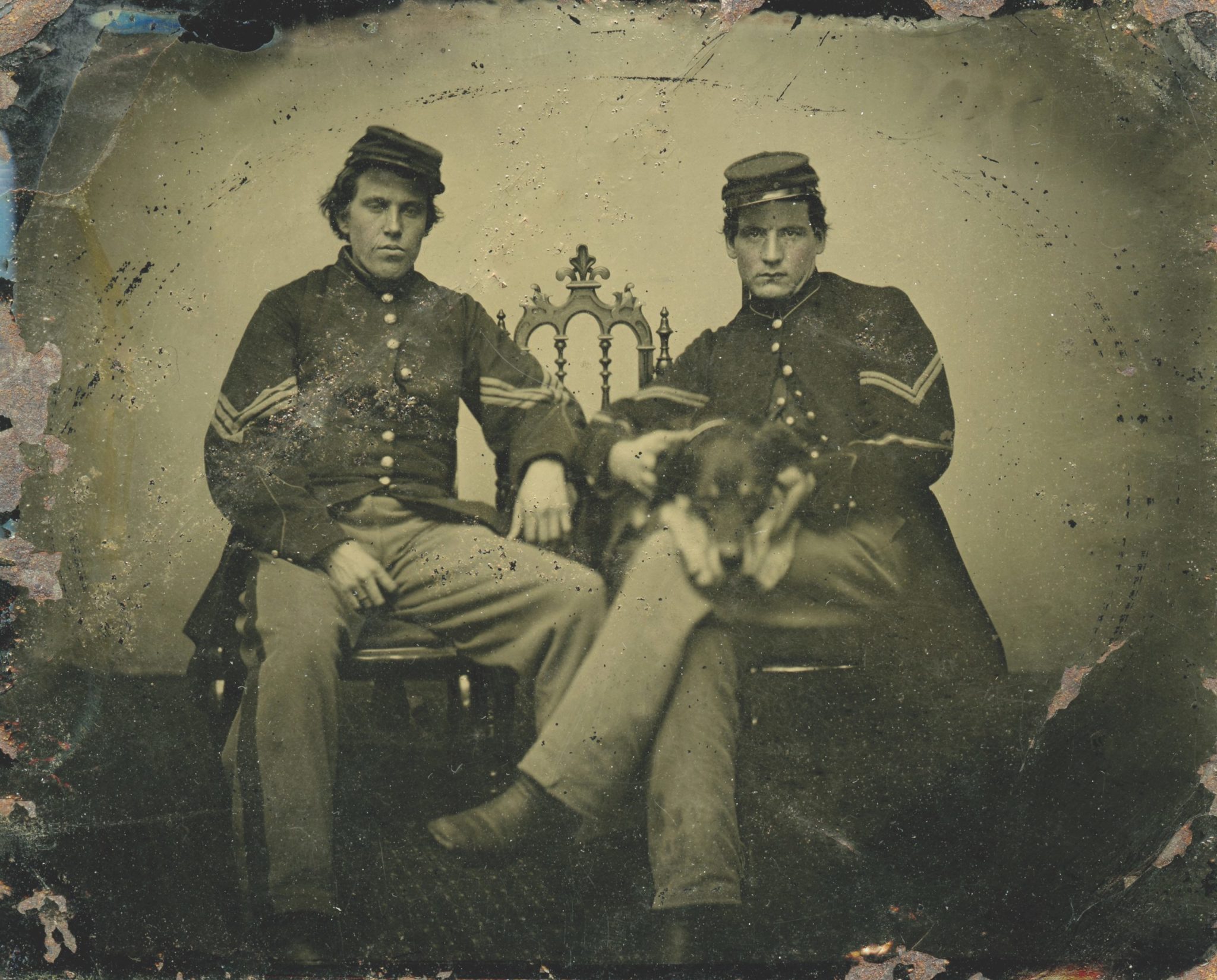
The Newfoundland (And Other Canine) Heroes Of The CIvil War
(The Newfoundland In History - The Newfoundland.org)
"When Johnny Reb and Billy Yank marched off to war, chances are that a four-footed or winged creature went with them. Wartime animal mascots demonstrated bravery and loyalty, and earned the affections of their human counterparts. Dogs and horses were most commonly mascots for regiments, but a dignified eagle, a lumbering bear, and a sheep also had their place in camp and on the battlefield. Some Civil War mascots were an inspiration for the troops, while others were a reminder of beloved pets at home. Mascots brought loyalty and enthusiasm, and for soldiers, the act of nurturing animals also offset boredom in camp.
Some accounts of Newfoundlands serving as mascots during the civil war include:
"A large dog called 'Tony' who was a beautiful Newfoundland Dog lovingly cared for by the Chicago Light Artillery Battery A. He was called the 'Battery dog.' Tony was a dog of action and gave no thought to the bullets zipping all around him. He was on the battlefields at South Mountain and the wounded at Fort Donelson. He saw action again at Shiloh. He never got separated from his men so when he came up missing at Antietam the worst was feared. Unfortunately, he was killed and found beside the body of W.J. Pollock, Co H. 20th New York Infantry."
The 104th Ohio was truly a group of animal lovers, adopting as their mascots a cat, a tame raccoon, a white bulldog named 'Old Harvey' and a Newfoundland.
"On the sixth of October, eighteen hundred and sixty one, as the regiment was on it's way to the seat of war, there came on board the train at Portsmouth, New Hampshire, a large, black, Newfoundland dog, weighing considerably upwards of one hundred pounds. Entering the car occupied by company H, Capt. Emerson, he was adopted by the members of that company and christened 'Major.' From that time until May eight, eighteen hundred and sixty-three, when the regiment was mustered out of service, he continued a member of this company, (never but once deigning to recognize a person belonging to any other, and that during Banks' retreat from Winchester when he became so crippled from continuous travel that it was with the utmost difficulty he could proceed,) sharing with almost human patience and fortitude all the vissitudes of camp life, with as much sense of duty, apparently, as if he had been duly enlisted and mustered for the war." Major went on to serve with the 29th Maine, where he was killed at the Battle of Mansfield Landing in Louisiana.
In a retelling of the incidents at Pittsburgh Landing (also known as Shiloh) "Private John K. Ferguson, company K, Sixty-fifth Ohio, who was killed in the second day's battle, was accompanied to camp by a young Newfoundland dog, who had persistently followed him from the time of his enlistment, and from camp to camp, to the moment of his death. Two days after the battle the faithful dog was found lying upon the inanimate breast of his master; nor would he consent to leave the spot until the remains were buried."
A history of the famous Iron Brigade, the 6th Wisconsin relates the following from the Battle of Antietam: "At the very farthest point of advance on the turnpike, Captain Werner Von Bachelle, commanding company F, was shot dead. Captain Bachelle was an ex-officer of the French army. Brought up as a soldier in the Napoleonic school, he was imbued with the doctrine of fatalism. His soldierly qualities commanded the respect of all, and his loss was deeply felt in the regiment. Bachelle had a fine Newfoundland dog, which had been trained to perform military salutes and many other remarkable things. In camp, on he march and in the line of battle, this dog was his constant companion. The dog was by his side when he fell. Our line of men left the body when they retreated, but the dog stayed with his dead master, and was found upon the morning of the 19th of September lying dead upon his body. We buried him with his master. So far as we know, no family or friends mourned poor Bachelle, and it is probable that he was joined in death by his most devoted friend on earth."
Subscribe to:
Posts (Atom)